
 All articles
We Forgot How to Build with Soul. AI Is About to Change That.

 July 23, 2026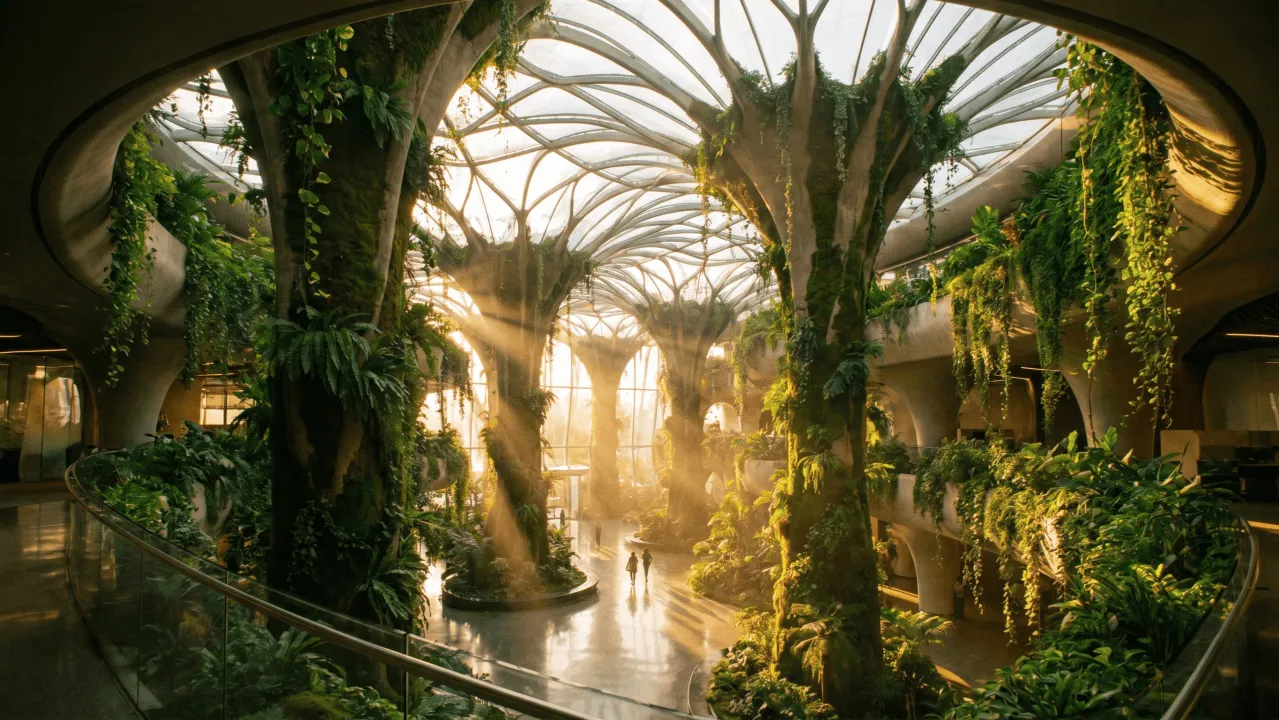
Look at the building you’re in right now. Then close your eyes and picture a cathedral built 800 years ago. One was designed to be efficient. The other was designed to matter.
Walk through the old parts of any European city and something happens to you that doesn’t happen in a modern business park. You slow down. The details pull you in. A carved stone face above a doorway. The curve of an iron lamppost. The way light moves through a stained glass window cut by someone who would never see the building finished. Look at the Ponte Vecchio in Florence, the Art Nouveau Metro entrances Hector Guimard built in Paris, the tail-finned cars of the 1950s, the mechanical watches of the 18th century where every gear was hand-fitted by someone who understood that no one would see it but God. These things were made by people who believed that everything they touched deserved to be made as well as it could possibly be made.
Then the industrial age arrived and replaced that WHY.
The new WHY was efficiency. Then profit. Then volume. Everything had to be reproducible at scale, which meant everything had to be the same. Henry Ford said you could have any colour as long as it was black, and he wasn’t joking. Standardisation was the answer to cost, and cost was the only question anyone was asking. The curve became a straight line because straight lines were simpler to manufacture. The detail disappeared because detail cost money. The soul drained out somewhere between the production line and the quarterly report.
We told ourselves that was progress. What it was, was a trade. We traded meaning for volume. And for a long time, it was a trade most people didn’t notice, or couldn’t afford to refuse.
That trade is now over.
Here is how AI generative design works.
You give the AI system a purpose: this bracket must carry this load, within these dimensions, using no more than this amount of material. Then the system doesn’t try one solution. It runs thousands of design branches simultaneously, each one a different interpretation of your constraints, each one tested, scored, and branched again into the next generation of variations. It is massive parallel simulation, the same process evolution runs in nature, not one species at a time, but millions of variations across millions of generations, the successful ones surviving to produce the next round. The difference is that nature takes millennia. The AI system takes hours.
What comes back is not what any single engineer would have drawn. It is what the entire solution space produces when you let it run. And it almost always looks organic. Branching, asymmetrical, intricate, nothing like what a human hand would draft on a screen. That is because the process that produced it is identical to the process that produced bone, coral, and the root system of a tree. You are looking at the same algorithm, running faster.
Airbus and GM ran the experiment.
Airbus put this to work on a cabin partition. Engineers had used the same basic structure for decades. The generative system returned something that looked like the cross-section of a deep-sea creature: branching, irregular, nothing a conventional designer would have proposed. It was 45 percent lighter and passed every structural test. GM redesigned a seat bracket the same way. Eight separate components became one. 40 percent lighter. 20 percent stronger. The parts that came back looked grown, not designed.
This is the shift that matters: beauty, complexity, and detail are no longer costs. They are outputs. The system doesn’t simplify to reduce expense. It produces whatever is optimal, and what is optimal tends to be intricate, specific, and exactly suited to its purpose. Every branch that survived the simulation earned its survival. Nothing in the final result is decoration. Everything is there because it works. The beauty is a side effect of the optimisation, which is exactly how it works in nature.
Combined with 3D printing, this changes what manufacturing can mean. In conventional production, a complex shape costs more than a simple one: tooling, moulds, and assembly steps all add cost. In additive manufacturing, complexity costs nothing. The machine builds what the design specifies, layer by layer, regardless of how intricate the geometry is. Which means that for the first time since the industrial age began, making something individual, detailed, and specific to a person is not a premium. It is simply a choice.
And this is where the WHY comes back.
In my books I write about the separation that industrialisation created between the WHY of a thing and its HOW and WHAT. Craftsmen once held all three together. They understood who the object was for, what feeling it should carry, what purpose it should serve. The industrial age took the HOW and WHAT and gave them to machines, and reduced the WHY to a single question: can we make more of this for less? The WHY of the industrial age was never really about the person holding the product. It was about the person reading the balance sheet.
Generative engineering restores the original order. Humans bring the WHY: the intention, the values, the specific person or purpose the thing is designed to serve. The AI brings the HOW and WHAT: the geometry, the structure, the configuration that performs best within the given constraints. And because complexity costs nothing, the WHY can now be genuinely specific. Not a product designed for an average customer who doesn’t exist. A product designed for you, for this use, in this context, carrying this intention.
This is the creative renaissance that most people haven’t noticed yet. Not because it isn’t happening, but because it looks technical from the outside. Aerospace brackets that look like coral. Medical implants shaped like the inside of a bone. Building facades that shade themselves differently depending on where the sun hits, because the structure was grown to do exactly that. These are not beautiful objects with engineering underneath. They are objects where beauty and engineering have become the same thing again, the way they were in every cathedral, every bridge, every lamppost made before efficiency became the only god worth worshipping.
The old buildings had soul because the person who made them cared about the person who would use them. That relationship was broken by industrialisation, not because people stopped caring, but because the economics of scale made caring too expensive.
Those economics have changed. Complexity is free. Individuality costs no more than standardisation. And the only thing needed to put soul back into what we make is a WHY worth building toward.
The tools are ready. The question is whether we are.
Over to you.
Look at what your organisation makes or builds. Where has the WHY shrunk down to efficiency and margin? And where could it expand again, now that the constraint of complexity has gone?
If you could design one product or service with no limit except that it had to carry genuine purpose, what would it be?
Share in the comments. I read every one.
Christian Kromme writes The Human Spark – Beyond AI, a newsletter about what it means to be human in a world being reshaped by technology.