
 All articles
AI Is Humanity’s Neo-Cortex. Nature Built the First One.

 July 16, 2026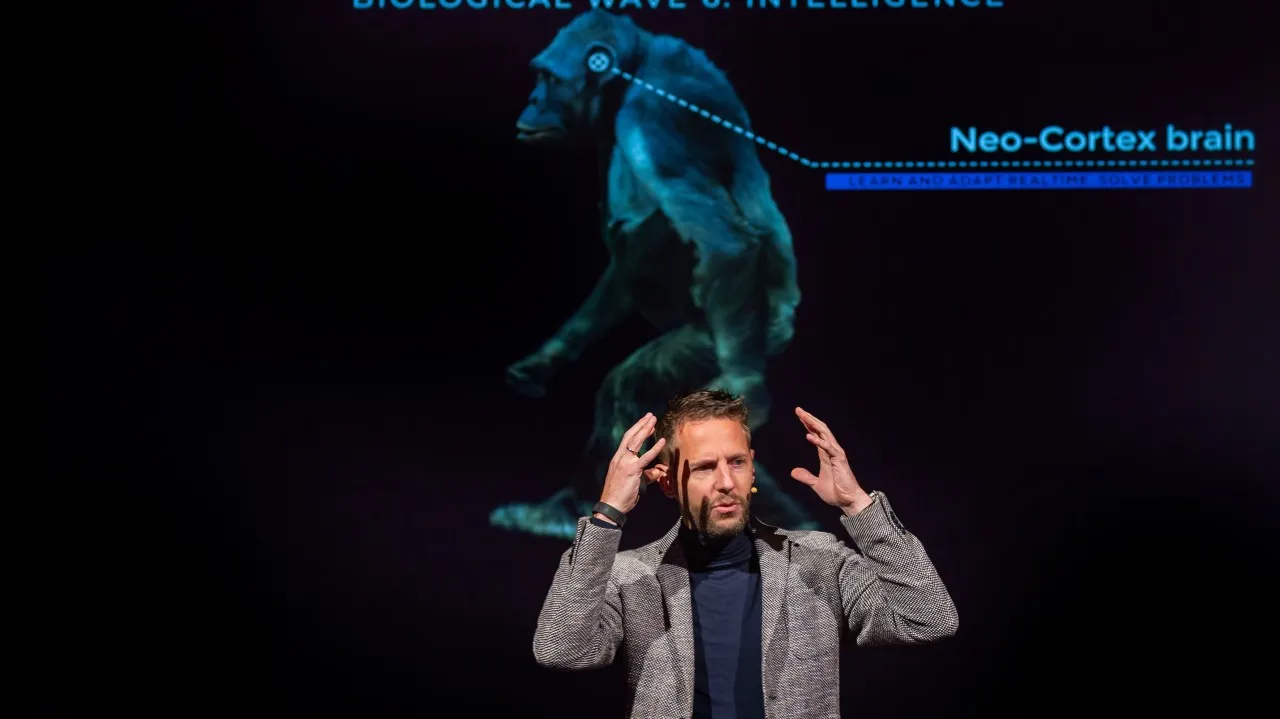
Technology doesn’t emerge by accident. Every wave that has swept through human history arrived because something was needed, and left behind a problem that made the next wave necessary.
This isn’t coincidence. It’s a pattern as old as life itself.
Each new technology solves a genuine human need. The printing press met the need to spread knowledge beyond those who could afford scribes. The steam engine met the need to move weight across distance without exhausting bodies. The internet met perhaps our deepest cognitive hunger: the need to find information, connect with others, and belong to something larger than our immediate community.
And then something predictable happened. The solution became the next problem.
Social media is the clearest recent example. It filled our need for connection and information beautifully. It gave us access to ideas, communities, and voices from across the world. But in doing so, it started behaving exactly like the part of the brain it was built to satisfy: the mammal brain. The social brain. The part wired to avoid pain and move toward pleasure.
Watch what happens in a herd of animals when a threat appears. They don’t stop to think. They run, left or right, together, away from the danger. It costs an enormous amount of energy. Most of that energy is wasted. The herd disperses, exhausted, and the threat is rarely gone.
Look at what’s happening in society today and you’ll see the same pattern. Something disturbing enters the world and people move, fast, to one side or the other. No pause. No reflection. Just the pull to join a group and move away from what feels threatening. Social media, built on the logic of the mammal brain, amplifies this at scale. It punishes nuance and rewards reaction. It is, in the most literal sense, a collective mammal brain running at digital speed.
Nature faced exactly this problem before. And nature solved it.
When early organisms grew complex enough that the mammal brain could no longer manage the signals coming in, something new emerged: the neo-cortex. The rational brain. The part that can pause before reacting, hold two conflicting ideas at the same time, and choose a response rather than just produce one. The neo-cortex didn’t replace the mammal brain. It sat above it, observing it, regulating it, giving the organism the capacity to act from reflection rather than reflex.
Now look at what we’re building with AI.
We are taking the output of billions of human minds, the full noise and signal of the internet age, and building systems that can step back from it, find patterns across it, hold contradictions within it, and return something more considered than any individual reaction could. AI in the cloud is not an accident. It is humanity building its neo-cortex. The same problem, at a different scale, arriving at the same kind of solution.
I call this emergent behaviour. It doesn’t matter whether you’re looking at cells organising into an organism or humans organising into a civilisation. At a certain level of complexity, the same problems appear. And at that level of complexity, the same kinds of solutions emerge. Not because anyone planned it. Because the pattern runs deeper than any plan.
Nature didn’t design the neo-cortex to solve polarisation. It emerged because the system needed it. We didn’t design AI to solve societal fragmentation. But that may be exactly what it’s here for, if we’re paying attention.
This is why I don’t read the rise of AI as a threat to what makes us human.
It arrived at the exact moment in our collective development when we needed something to help us regulate the collective mammal brain we’ve built at planetary scale. That’s not a coincidence. That’s biology repeating itself at a larger size.
The question worth sitting with is not whether AI is dangerous. The question is whether we’ll use it the way the neo-cortex was meant to be used: not to replace instinct, but to observe it, understand it, and choose what to do with it.
Nature took millions of years to get there. We have considerably less time.
Over to you.
Does this pattern resonate with you? Do you see AI as something humanity stumbled into, or as something that had to arrive at this particular moment in our development?
And if nature and technology really do follow the same logic, what does that tell us about what comes next?
Share your perspective in the comments. I read every one.
Christian Kromme writes The Human Spark – Beyond AI, a newsletter about what it means to be human in a world being reshaped by technology.