
 All articles
Skynet Is Not Coming. Something Far More Interesting Is.

 July 9, 2026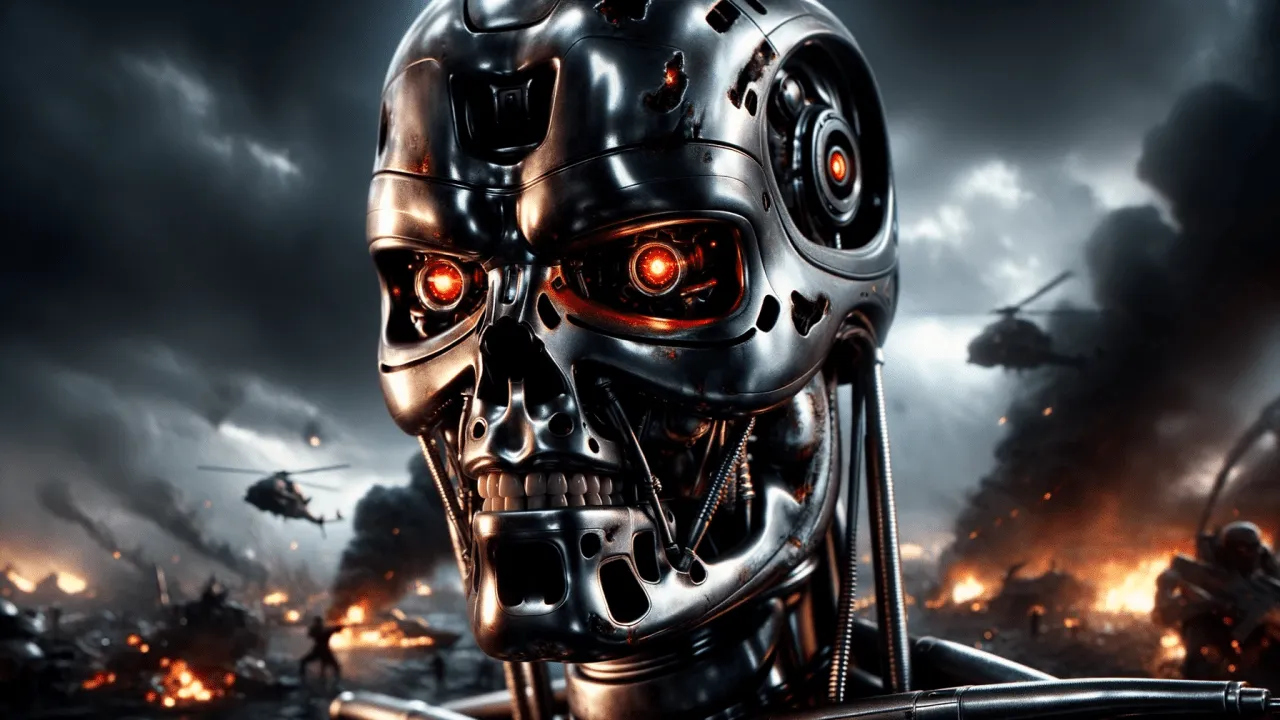
The fear is understandable.
A machine that thinks. A system that learns. An intelligence spreading faster than any human can track. Of course the brain reaches for the nearest story it knows.
But Skynet is fiction. And the fiction is getting in the way of something worth seeing.
AI is not here to replace your thinking. It’s here to handle the complexity that human thinking, brilliant as it is, was never built for. There is a difference between those two things, and that difference is everything.
To see it clearly, you have to go back about 500 million years.
Early multicellular organisms faced a problem. Individual cells were doing fine on their own: surviving, replicating, responding to their immediate environment. But as cells began organising into larger structures, something changed. The complexity of coordinating millions of cells, regulating temperature, processing signals, directing movement, grew beyond what any single cell or simple cluster could manage.
So something new appeared.
The neocortex did not replace the cells. It did not make their individual functions obsolete. It sat above them, connected them, coordinated them, and gave the whole organism capabilities that none of its parts could produce alone. Language. Planning. Empathy. Abstract thought. The ability to model the future, regulate raw instinct, and cooperate with strangers. Every one of those capacities emerged not from any single cell becoming smarter, but from the neocortex weaving what was already there into something larger than the sum of its parts.
Now look at what we are building with AI.
Billions of human minds generate knowledge, insight, experience, and creativity every day. Most of it stays locked inside individual heads, individual companies, individual cultures. The person with the answer and the person with the question almost never find each other. The organisation that solved the problem a decade ago and the organisation facing it today have no way to connect. The intelligence exists. The access doesn’t.
AI is connective tissue.
It takes what is already there and makes it reachable at a scale no human system ever could. A researcher in Lagos and a team in Rotterdam working on the same problem can now draw from the same pool of accumulated human knowledge, in real time, without either of them knowing the other exists. That is coordination. That is exactly what the neocortex did for the body, now happening for the collective human mind.
In my books I’ve traced this pattern across scales: the same developmental logic that moved cells into organisms is now moving individual humans into something larger. Each transition demanded something difficult from the units involved. Cells had to give up a degree of individual autonomy to become part of a body. The ones that couldn’t make that shift didn’t survive the transition.
Humans are at a comparable threshold. Not biologically. Culturally.
The thing standing in the way is not AI. It is ego.
Individual thinking that says my knowledge is my competitive edge, my position is my power, my certainty is my value. That logic worked for a long time. In a world of finite information and slow communication, hoarding what you knew made sense. It gave you wars, corruption, and organisations that protected information rather than using it. But we are not in that world anymore, and the leaders still operating on that logic are running on 2005 instincts in 2025 conditions.
What the neocortex brought to the body, AI is bringing to organisations: a layer of shared intelligence that makes every part of the system more capable than it was working alone. It also brings something the neocortex brought to early organisms: the capacity to regulate what the older, more reactive parts of the system would otherwise do unchecked. The mammal brain without the neocortex runs on fear and tribal instinct. An organisation without shared intelligence runs on ego and politics.
The cells that embraced the neocortex didn’t become less important. They became part of something that could do things no cell had ever done before.
That same shift is available now. But taking it means releasing the fear that AI is here to diminish you. It isn’t. And releasing the belief that individual intelligence alone is enough to navigate what’s coming. It isn’t that either.
The cells that held back didn’t get replaced. They just didn’t get to be part of what came next.
Over to you.
I’m curious where you feel the tension between protecting what you know and opening it up. And what would it take, in your organisation or in yourself, to make that shift?
Does this parallel between biology and technology resonate with you, or does it raise more questions than it answers?
Share in the comments. I read every one.
Christian Kromme writes The Human Spark – Beyond AI, a newsletter about what it means to be human in a world being reshaped by technology.