
 All articles
Your Organization Is Not a Machine. It Is an Organism. And It Is Climbing the Same Ladder Life Already Climbed.

 August 20, 2026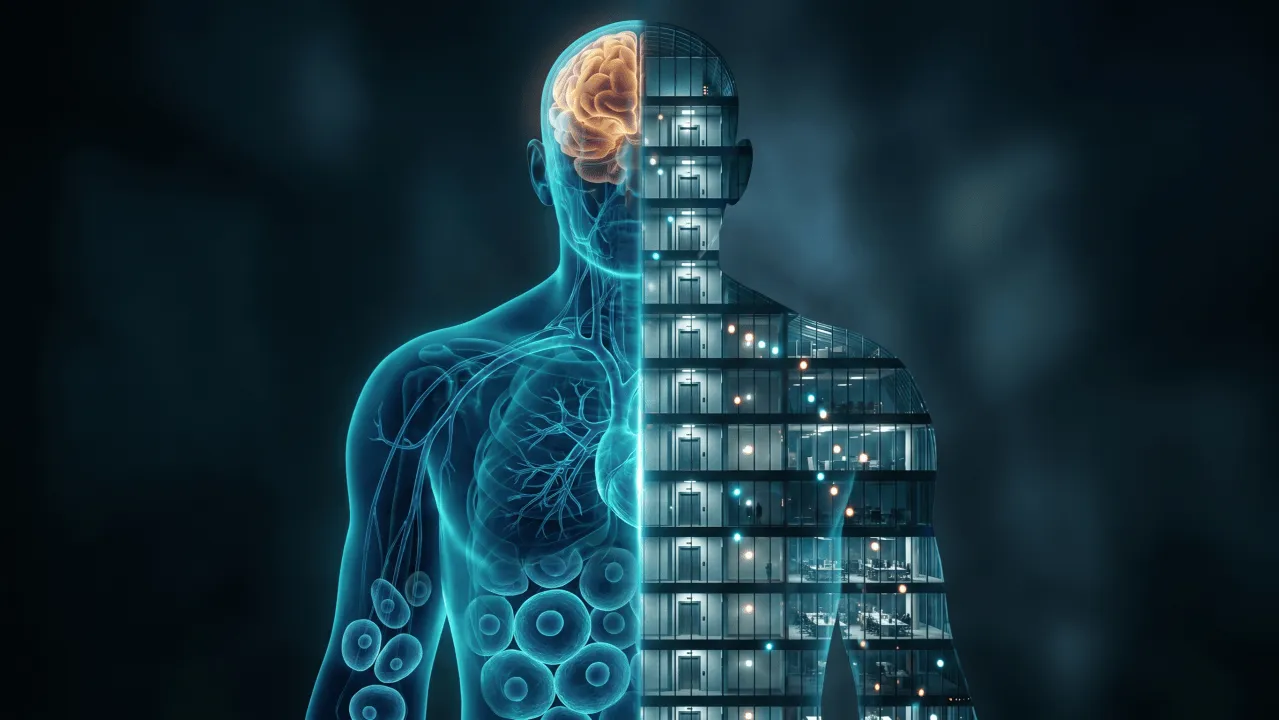
Life did not jump straight to the thinking brain. It built toward it, one layer at a time, over hundreds of millions of years. The cell came first. Then the body that carried many cells. Then the nervous system that connected them. Then the older brain that automated the basics, then the brain that read the world outside, and only at the very end the neocortex that could learn and reflect. Each layer sat on top of the one below. None of them could have arrived first.
Your organization is walking the exact same path. It does not know it. But every challenge it meets has already been solved once, by life, in the same order.
This is why I no longer think of companies as machines. A machine is assembled from the outside and runs the same way until it breaks. An organism grows from the inside, layer upon layer, and every layer has to be alive for the next one to work. Organizations behave like organisms because they are made of living things doing the one thing life has always done: solving the problem in front of them, then discovering that the solution created the next problem.
Your organization as an organism starts with the cell layer: culture
It starts where life started. A single cell survives by communicating and sharing a purpose with the cells around it. That is the first layer, and in an organization we call it culture. Not the values painted on the lobby wall. Culture is what happens the moment someone makes a mistake. It is whether people share what they know or quietly hold it back. Google studied hundreds of its own teams and found that psychological safety predicted performance more than anything else they measured. A cell under stress hardens its membrane and stops talking to its neighbours. People do precisely the same thing. And no technology you buy can soften a membrane that has already closed.
The body: infrastructure that moves resources
A colony of cells that survives starts to grow, and growth creates the second problem. How do you move resources to where they are needed? Life answered with infrastructure: a vascular system, a way to carry energy reliably to every part of the body. Organizations answer with their business model and their operational backbone. The danger is that infrastructure built for one environment becomes a trap when the environment changes. The largest creatures that ever lived had magnificent bodies, perfectly tuned to a world that then disappeared. Their size, once their advantage, became the thing they could not escape. A fluid organism beats an optimized one the moment the ground shifts.
The nervous system: how information travels
Infrastructure solves distribution and creates the third problem. Once resources are moving, how do you know where they are needed right now? Life grew a nervous system: sensors, signals, a constant exchange between inside and outside. In an organization this is the information layer. And this is the layer most leaders underestimate, because everything they hope to build later depends on it. If signals arrive late, broken, or trapped in one department, the rest of the body is flying blind. You cannot think clearly on bad nerves.
The oldest brain: automation, and the rigidity that follows it
Then the nervous system works too well, and floods the system with more than it can handle. Life met that overload with the oldest brain, the one that automates the routines so attention is freed for what matters. Useful, until automation hardens into rigidity and the system can only follow the rule, even when the moment asks for judgment. Every organization carries both failures at once. Work that is still done by hand when it should run itself, and rigid processes that say no precisely when a human should have said yes.
With the basics automated, life could finally look outward. The mammal brain emerged to read the environment, copy what worked, and adapt faster than any single creature could alone. In an organization this is the layer that touches the outside world: the customers, the market, the early signals of change. A company without it learns about its problems only after the customer has already left, and about the shift in its market only after the window has already shut.
The neocortex: where AI actually sits
And then, on top of all of it, the thinking layer. The neocortex did not replace anything beneath it. It integrated every layer below and gave life something new: the ability to learn in real time, to hold complexity, to cooperate at a scale no individual could reach. This is where AI now lives in the organization. It is the newest layer, and it obeys the oldest rule. It can only amplify a capacity that is already there. Give it a body that knows how to learn and it learns faster. Give it one that repeats its mistakes and it repeats them faster too.
This is how technology makes us more human rather than less. AI does not do the human work for you. It does not build the trust, listen to the customer, or learn from the failure. It reveals, with uncomfortable precision, whether you did that work at all. The same waves that shaped a billion years of biology are now moving through your company, and the technology arriving at the top of the stack only shows you how alive the layers underneath really are.
The cells that adapted to the neocortex did not become less important. They became part of something that could do things no individual cell had ever done before. That same transition is available now. The wave is rising. The question is what you are building underneath it.
Over to you.
If your organization really is an organism climbing this ladder, which rung is it standing on right now? And which layer beneath it, the culture, the infrastructure, the flow of information, is quietly holding the whole body back?
Tell me what you see when you look at your own company this way. I read every comment.
Christian Kromme writes The Human Spark – Beyond AI, a newsletter about what it means to be human in a world being reshaped by technology.